
 |
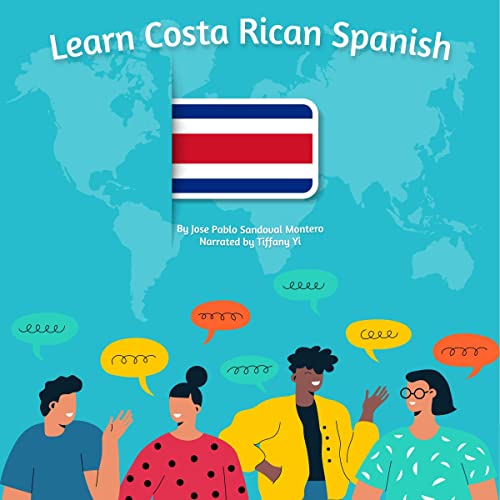
Learn Costa Rican Spanish: A Spanish Course for Costa Rican Work and Travel (Audible Audiobook)
This guide focuses on the uniqueness of the Costa Rican dialect, as well as aspects of its culture and history to prepare you to visit or live in the country, such as street Spanish or pachuco, awareness of Costa Rican weather, foods, idioms, expressions, and dialects. And, of course, unique costarriqueñismos, such as pura vida and beyond. This is a great introduction to the nuances of Costa Rican Spanish! |

An Overview of Costa Rican Spanish
Native speakers: 4 million.
Costa Rican Spanish is the form of the Spanish language spoken in Costa Rica. Costa Ricans are colloquially called "ticos" (based on the frequent use of the diminutive ending -ico following a /t/, as in momentico), and thus colloquial expressions characteristic of Costa Rica are called tiquismos. Tiquismos and pachuquismos are used frequently in Costa Rica. The latter are expressions of popular street Spanish which can be considered vulgar and offensive if used in the wrong context. Many of these words, even when found in a standard Spanish dictionary, do not have the same meaning there as in Costa Rica. Learning colloquial expressions can be a guide to understanding the humor and character of the Costa Rican culture.
Usted is the predominant second person singular pronoun in Costa Rican Spanish. Some speakers use only usted in addressing others, never vos or tú. Others use both usted and vos, according to the situation.
Vos is a second person singular pronoun used by many speakers in certain relationships of familiarity or informal contexts. Voseo is widely used between friends, family, people of the same age, etc. It is also commonly used in the university context between students. Some adults use vos to address children or juveniles, but other adults address everyone regardless of age or status with usted. Costa Ricans tend to use usted with foreigners.
Tú is rarely used in Costa Rican Spanish. However, due in part to the influence of Mexican television programming, Costa Ricans are familiar with tuteo, and some television viewers, especially children, have begun to use it in limited contexts.
Source: Wikipedia
Costa Rican Spanish is the form of the Spanish language spoken in Costa Rica. Costa Ricans are colloquially called "ticos" (based on the frequent use of the diminutive ending -ico following a /t/, as in momentico), and thus colloquial expressions characteristic of Costa Rica are called tiquismos. Tiquismos and pachuquismos are used frequently in Costa Rica. The latter are expressions of popular street Spanish which can be considered vulgar and offensive if used in the wrong context. Many of these words, even when found in a standard Spanish dictionary, do not have the same meaning there as in Costa Rica. Learning colloquial expressions can be a guide to understanding the humor and character of the Costa Rican culture.
Usted is the predominant second person singular pronoun in Costa Rican Spanish. Some speakers use only usted in addressing others, never vos or tú. Others use both usted and vos, according to the situation.
Vos is a second person singular pronoun used by many speakers in certain relationships of familiarity or informal contexts. Voseo is widely used between friends, family, people of the same age, etc. It is also commonly used in the university context between students. Some adults use vos to address children or juveniles, but other adults address everyone regardless of age or status with usted. Costa Ricans tend to use usted with foreigners.
Tú is rarely used in Costa Rican Spanish. However, due in part to the influence of Mexican television programming, Costa Ricans are familiar with tuteo, and some television viewers, especially children, have begun to use it in limited contexts.
Source: Wikipedia

Costa Rican Spanish Learning Books
 |
Costa Rican Spanish: Speak like a Native!
Don’t settle for generic Spanish! Put away the stale phrasebooks and learn to speak just like the natives! Join us as we explore the most common expressions in Costa Rica. Does a choricero sell sausage? If someone says to you ¡Qué camote!, is he vegan? Discover the real meaning behind the words. Make friends and save money at the market. Start learning Spanish…one country at a time.The Gringo Guide 200 series of books have sold thousands of copies the world over. Our guidebooks are not meant to teach you basic Spanish, but rather to tailor your Spanish to the spoken idiosyncrasies of each Spanish-speaking country. |
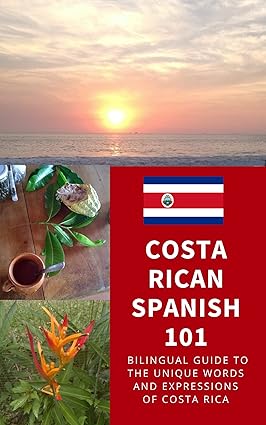 |
Costa Rican Spanish 101: Bilingual Dictionary and Phrasebook for Spanish Learners and Travelers to Costa Rica
Costa Rican Spanish 101 reveals the Spanish language as it's used by ticos in the Central American country of Costa Rica. This guide reveals over 200 uniquely Costa Rican Spanish words and expressions with definitions and examples in both Spanish and English. This is must-have before you think about retiring in Costa Rica or boarding the plane to San Jose. |
 |
Dictionary of Costa Rican Slang / Diccionario de Palabrotas y Coloquialismos Ticos
The most up-to-date collection of contemporary Costa Rican slang with a complete English translation and equivalents! Contains over 750 expressions and has seven full color cartoons. Written by a Costa Rican, the dictionary is perfect for visitors, students and residents who want to understand the locals. A variety of slang words and expressions ranging from the most vulgar and offensive to the most informal are defined and presented in context with colorful examples. In addition, each entry is matched up with a possible English slang word or expression. |
 |
Lonely Planet Costa Rican Spanish Phrasebook & Dictionary
This is your handy passport to culturally enriching travels with the most relevant and useful Costa Rican Spanish phrases and vocabulary for all your travel needs. Discuss the wildlife with the locals, banter in Coast Rican slang and bargain like a pro -all with your trusted travel companion. With language tools in your back pocket, you can truly get to the heart of wherever you go, so begin your journey now! |
 |
Tico Slang: Learning Costa Rican Spanish One Word at a Time
No matter whether traveling to Costa Rica as a tourist, a student, or with the intention of moving to the country as an expatriate, this guide will serve you well. You probably already know the Spanish spoken by Ticos (Costa Ricans) is a distinct and unique language, rich with words and phrases they don't teach in high school Spanish class. Intended for English speakers, this book's shares common slang words and phrases (Tiquismos) that will help you communicate in everyday situations like ordering dinner in a restaurant, shopping at the market, flirting, getting street directions, or hiring a taxi. |
Costa Rican Spanish Language Courses

|
1-on-1 Spanish tutoring at italki
One-on-one language tutoring at italki is hands down the most efficient way to reach language fluency. That's why it is the most popular platform today for learning a language online. You can practice conversational skills under different real-world scenarios with a native speaker tutor of your choice who provides you with undivided attention and customized lessons that cater to your learning needs and interests. Whether you’re at home, at the airport, or at your local park, you have complete access to learning Costa Rican Spanish or any other language you want with a native speaker from any country of your choice. SPECIAL OFFER: Get $10 italki credits by joining via this link. |

|
Spanish Uncovered: The World’s First StoryLearning Spanish Home Study Course
This new, science-based language learning method was invented by polyglot language expert Olly Richards, who has authored more than a dozen best-selling language books available in bookstores around the world and on Amazon.com. This was the method he used to learn eight languages, and is the exact same method he has been using to help thousands of students learn Spanish. The course comes in both Castilian and Latin American versions, which means that it works for you whatever variety of Spanish you're learning. Find out more! |

|
Baselang's Real World 1-on-1 Spanish tutoring
This top-rated program offers UNLIMITED 1-on-1 Spanish tutoring where you can take as many online Spanish classes as you want, on a daily basis if you wish, with their professional teachers from all around Latin America for a monthly flat rate. Baselang's classes are specifically tailored to your level, from zero to advanced. Don't miss this amazing opportunity! |

|
Preply
Preply is a global online language learning platform designed to promote faster learning with one-on-one online tutors. It connects language tutors with millions of learners from all over the world. You can choose from thousands of Spanish teachers from any country of your choice available in the platform. Book a lesson with a private Spanish teacher today and start learning. Not entirely happy with your tutor? No worries, Preply offers free tutor replacement till you're 100% satisfied. |
 |
Learn Costa Rican Spanish with SpanishPod101.com
SpanishPod101 has loads of high-quality audio and video lessons that cater to students from absolute beginner level to upper-intermediate level. Covering a wide range of subjects, the lessons explore anything from Hispanic culture and particular grammar points to specific scenarios and essential vocabulary. Signing up with SpanishPod101 gives learners access not only to its Costa Rican Spanish modules but also its Mexican Spanish, Peruvian Spanish, and even European Spanish modules. |

|
Maximo Nivel Spanish Schools in Costa Rica
The Maximo Nivel Spanish immersion program in Costa Rica pushes you to apply your studies both inside and outside of the classroom. Whether you choose to study in the capital city of San Jose or at the beach in Manuel Antonio, you can rest assured that Maximo Nivel provides the same high quality Spanish instruction. All courses are led by certified native Spanish-speaking teachers. In the classroom, learners and teachers utilize Spanish conversation, context, and visuals to ensure understanding of vocabulary and grammar. Through a structured curriculum that emphasizes speaking, you naturally acquire the language as you are pushed to learn through practice. Come learn Spanish in the land of “Pura Vida” for a fun and intensive Spanish language program! |
Costa Rican Spanish Learning Podcasts

|
Podcast on Costa Rica by Lengalia
Listen to native speakers from Costa Rica telling interesting facts about their country, culture and language in Costa Rican Spanish accent. |
Costa Rican Spanish Learning Blogs

|
30 Costa Rican Slang Words To Talk Like A Real Tico
An excellent blog article on Costa Rican Spanish slang by Baselang. With Baselang's UNLIMITED 1-on-1 online Spanish tutoring you can take as many online Spanish classes as you want with their professional teachers for a monthly flat rate. Don't miss the opportunity! |

|
¡Qué Chiva! 23 Cool Costa Rican Slang Words from the Happiest Place on Earth
A great blog article on Costa Rican Spanish slang by FluentU. |

|
Costa Rican Spanish Learning Apps
|
Costa Rican Newspapers
Costa Rican Newspapers is an application that groups all news of the most important newspapers and magazines of Costa Rica. With this application you can have in one place, all the information you want without browse individual websites of each newspaper or magazine. |
1-on-1 Costa Rican Spanish Lessons at italki
|
italki is the most flexible and affordable language learning platform that connects students with the most dedicated teachers around the world for 1-on-1 online language tutoring through video chat. At italki, you can choose an experienced Costa Rican Spanish teacher for your personal tutor based on your goals and interests.
Here is a step-by-step instruction to find a native Costa Rican Spanish teacher at italki:
Good luck and enjoy your lesson! |
 |
Home | About | Contact Us | Disclosure | Privacy Policy
This page contains affiliate links. For more information, see our disclosure page.
Copyright © 2024 LearnLatinAmericanSpanish.com
This page contains affiliate links. For more information, see our disclosure page.
Copyright © 2024 LearnLatinAmericanSpanish.com
