
 |
Learn Peruvian Spanish: A Spanish Course for Peru (Audiobook)
This audiobook provides insight into the language and customs of Peru through its language. Though Peru is a Spanish-speaking country, there are marked differences in the evolution and usage of the Spanish language in Peru, which this book highlights. Core vocabulary is covered in addition to the unique words and phrases of Peru. All vocabulary is recorded in an authentic Peruvian dialect, making it easy for you to learn the nuances of Peruvian Spanish and develop an appropriate accent. Topic covered include common words and phrases regarding greetings, colors, the weather, ordering in restaurants, and simple sentence construction. Whether you are traveling to Lima, Cusco, Arequipa, Chiclayo, Iquitos, Trujillo, or any of the other fascinating cities and places in Peru, this 10-session course will provide you with the vocabulary and language knowledge that you need to communicate effectively in terms of speaking and understanding Peruvian Spanish and being aware of important aspects of Peruvian language and culture. You can learn in the car, on a walk or run, while in bed, or while doing household chores. Start your journey learning Peruvian Spanish today! |

An Overview of Peruvian Spanish
Native speakers: 33 million.
Peruvian Spanish is a family of dialects of the Spanish language that have been spoken in Peru since brought over by Spanish conquistadors in 1532.
During colonial and early republican times, the Spanish spoken colloquially in the coast and in the cities of the highland possessed strong local features, but as a result of dialect leveling in favor of the standard language, the language of urban Peruvians today is more or less uniform in pronunciation throughout most of the country. Vestiges of the older dialect of the coast can be found in the speech of black Peruvians, which retains Andalusian features such as the aspiration or deletion of final /s/ and the deletion of final /r/. The dialect of Arequipa, Loncco, in its pure form is now extinct, although some elders are familiar with it.
Throughout most of the highland, Quechua continued to be the language of the majority until the mid 20th century. Mass migration (rural exodus) into Lima starting in the 1940s, and into other major cities and regional capitals later on, accompanied by discrimination and the growth of mass media, have reconfigured the linguistic demography of the country in favor of Spanish. The poor urban masses originating in this migration adopted the standardized dialect spoken in the cities, however with traces of Andean pronunciation and a simplified syntax.
There are four varieties spoken in the country today, namely Andean Spanish, Peruvian Coast Spanish, Andean-Costal Spanish, and Amazonic Spanish. The majority of Peruvians speak Peruvian Coast Spanish, which has the reputation (in pronunciation) of being one of the "purest" dialects in all of coastal Latin America. It is the characteristic dialect as perceived abroad and has the reputation of being the base of "normal" or standard Peruvian Spanish.
Source: Wikipedia
Peruvian Spanish is a family of dialects of the Spanish language that have been spoken in Peru since brought over by Spanish conquistadors in 1532.
During colonial and early republican times, the Spanish spoken colloquially in the coast and in the cities of the highland possessed strong local features, but as a result of dialect leveling in favor of the standard language, the language of urban Peruvians today is more or less uniform in pronunciation throughout most of the country. Vestiges of the older dialect of the coast can be found in the speech of black Peruvians, which retains Andalusian features such as the aspiration or deletion of final /s/ and the deletion of final /r/. The dialect of Arequipa, Loncco, in its pure form is now extinct, although some elders are familiar with it.
Throughout most of the highland, Quechua continued to be the language of the majority until the mid 20th century. Mass migration (rural exodus) into Lima starting in the 1940s, and into other major cities and regional capitals later on, accompanied by discrimination and the growth of mass media, have reconfigured the linguistic demography of the country in favor of Spanish. The poor urban masses originating in this migration adopted the standardized dialect spoken in the cities, however with traces of Andean pronunciation and a simplified syntax.
There are four varieties spoken in the country today, namely Andean Spanish, Peruvian Coast Spanish, Andean-Costal Spanish, and Amazonic Spanish. The majority of Peruvians speak Peruvian Coast Spanish, which has the reputation (in pronunciation) of being one of the "purest" dialects in all of coastal Latin America. It is the characteristic dialect as perceived abroad and has the reputation of being the base of "normal" or standard Peruvian Spanish.
Source: Wikipedia

Peruvian Spanish Learning Books
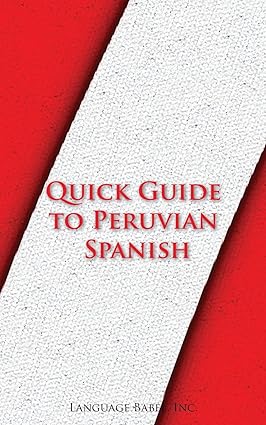 |
Quick Guide to Peruvian Spanish
This dictionary-style book of words and phrases helps you better understand Peruvian Spanish and slang. The collection of almost 500 terms and sayings will help you become familiar with the richness of Peruvian Spanish. It includes slang and vulgar words that you will likely run across in everyday conversations. Each term has been defined in English and synonyms are included when available. There are also more than 450 example sentences demonstrating how to use the words. You will be on your way to Peruvian Spanish fluency with this phrasebook of Spanish vocabulary words from Peru. This book contains words that are not appropriate for kids. If you are just starting to learn Spanish, this book is best used as a complementary reference source to any program or class designed to teach you Spanish. This book and the other books of the Speaking Latino series are not designed as stand-alone learning aids to teach you Spanish. Instead, they expand your country-specific Spanish vocabulary. If you already speak Spanish, this book help you understand local Spanish from Peru. |
 |
¿Quién me llama? Learn Peruvian Spanish Slang
Don't get caught out in Peru by not knowing at least a little of the local spanish slang. In this book, the most important slang words which are spoken day to day on the streets in Peru are explained in English. As an added bonus each word comes with a sample sentence in Spanish to help contextualise the use of each word. Who is this book? Anyone who wants to learn some of the Spanish slang that is used in Peru. For anyone planing to travel to Peru this book is a must have companion. Regardless of your level of Spanish, the contents of this book will give you some important words and phrases that will make your time in Peru that much more enjoyable by being able to communicate that much better with the locals. Don't go to Peru without a copy of this book. |
 |
¡Chapa tu jerga! A Peruvian Slang Guidebook
A Peruvian slang guidebook with more than 50 pages, 15 topics and examples for you to understand when to use it. Each slang contains a Spanish word and its translation into English. This little book will help you talk like a Peruvian. |
 |
Los castellanos del Perú: historia, variación y contacto lingüístico (in Spanish)
This book brings together contributions from leading researchers in Hispanic linguistics to offer a comprehensive overview of the Spanish varieties of Peru, including some that have traditionally been discriminated against, such as Andean, Amazonian, and Afro-Peruvian Spanish. The chapters focus on different varieties spoken in Peru from different theoretical and methodological approaches, taking into account their formation, their social and historical context and the contact phenomena that characterize them. Thus, although the volume has a very specific regional focus, the problems it addresses are of interest and relevance for the study of other varieties of Spanish, for the treatment of other problems derived from linguistic contact and for the dialectology and history of the Latin American Castilians in general. Written in Spanish, this volume will be of interest to graduate students in Hispanic linguistics and researchers dedicated to dialectology, sociolinguistics and contact linguistics. |
Peruvian Spanish Language Courses
|
1-on-1 Spanish tutoring at italki
One-on-one language tutoring at italki is hands down the most efficient way to reach language fluency. That's why it is the most popular platform today for learning a language online. You can practice conversational skills under different real-world scenarios with a native speaker tutor of your choice who provides you with undivided attention and customized lessons that cater to your learning needs and interests. Whether you’re at home, at the airport, or at your local park, you have complete access to learning Peruvian Spanish or any other language you want with a native speaker from any country of your choice. SPECIAL OFFER: Get $10 italki credits by joining via this link. |

|
Spanish Uncovered: The World’s First StoryLearning Spanish Home Study Course
This new, science-based language learning method was invented by polyglot language expert Olly Richards, who has authored more than a dozen best-selling language books available in bookstores around the world and on Amazon.com. This was the method he used to learn eight languages, and is the exact same method he has been using to help thousands of students learn Spanish. The course comes in both Castilian and Latin American versions, which means that it works for you whatever variety of Spanish you're learning. Find out more! |

|
Baselang's Real World 1-on-1 Spanish tutoring
This top-rated program offers UNLIMITED 1-on-1 Spanish tutoring where you can take as many online Spanish classes as you want, on a daily basis if you wish, with their professional teachers from all around Latin America for a monthly flat rate. Baselang's classes are specifically tailored to your level, from zero to advanced. Don't miss this amazing opportunity! |
|
Preply
Preply is a global online language learning platform designed to promote faster learning with one-on-one online tutors. It connects language tutors with millions of learners from all over the world. You can choose from thousands of Spanish teachers from any country of your choice available in the platform. Book a lesson with a private Spanish teacher today and start learning. Not entirely happy with your tutor? No worries, Preply offers free tutor replacement till you're 100% satisfied. |
 |
Learn Peruvian Spanish with SpanishPod101.com
SpanishPod101 has loads of high-quality audio and video lessons that cater to students from absolute beginner level to upper-intermediate level. Covering a wide range of subjects, the lessons explore anything from Hispanic culture and particular grammar points to specific scenarios and essential vocabulary. Signing up with SpanishPod101 gives learners access not only to its Peruvian Spanish modules but also its Mexican Spanish, Costa Rican Spanish, and even European Spanish modules. |
|
Academia Latinoamericana in Cusco, Peru
Imagine learning Spanish in one of the most beautiful and historic locations to be found anywhere in Latin America! You’ll be captivated immediately by the magic of Cusco: the ancient capital of the Inca Empire is set only a stone’s throw away from Machu Picchu World Heritage Site and at the very entrance to the Sacred Valley of the Inca. Your Spanish program in Cusco is much more than just a language course: it is guaranteed to be a deep plunge into history and into an ancient and mysterious culture. |
Peruvian Spanish Learning Podcasts
|
Peruvian Spanish Phone Conversations
This site contains hundreds of natural phone conversations on a broad range of topics, recorded by Peruvian native speakers at normal conversation speed. Perfect for improving your listening skills. Courtesy of Defense Language Institute Foreign Language Center. |

|
Podcast on Peru by Lengalia
Listen to native speakers from Peru telling interesting facts about their country, culture and language in Peruvian Spanish accent. |
Peruvian Spanish Learning Blogs

|
27 Peruvian Spanish Slang Words
An excellent blog article on Peruvian Spanish slang by Baselang. With Baselang's UNLIMITED 1-on-1 online Spanish tutoring you can take as many online Spanish classes as you want with their professional teachers for a monthly flat rate. Don't miss the opportunity! |

|
20 Peruvian Slang Words That’ll Have You Living the Good Life in Lima
A great blog article on Peruvian Spanish slang by FluentU. |
|
Peruvian Spanish Learning Apps

|
Radio Peru: Live Radio - On Google Play Hands down the best radio app to listen to FM radio stations from all over Peru. This app allows you to listen live all Peruvian radio broadcasts for free and online. The ergonomics of Radio Peru have been designed to be the simplest and fastest radio application. An indispensable tool to boost your Peruvian Spanish listening skills. |
1-on-1 Peruvian Spanish Lessons at italki
|
italki is the most flexible and affordable language learning platform that connects students with the most dedicated teachers around the world for 1-on-1 online language tutoring through video chat. At italki, you can choose an experienced Peruvian Spanish teacher for your personal tutor based on your goals and interests.
Here is a step-by-step instruction to find a native Peruvian Spanish teacher at italki:
Good luck and enjoy your lesson! |
 |
Home | About | Contact Us | Disclosure | Privacy Policy
This page contains affiliate links. For more information, see our disclosure page.
Copyright © 2024 LearnLatinAmericanSpanish.com
This page contains affiliate links. For more information, see our disclosure page.
Copyright © 2024 LearnLatinAmericanSpanish.com
